Jason Bock
| Home | Biography | Speaking | Articles | Books | Music |
Events, Tests, and Code Coverage
Last weekend I gave my “Writing Better Code” talk. While I was rehearsing the code coverage part, I was originally going to leave off the test assembly, but then I ran into something at the client last week that made me reconsider this proposition. Here’s the scenario. Let’s say you created a Workflow class in a Workflows assembly with an implementation that produces patriotic colors:
public abstract class Workflow
{
  public event EventHandler Completed;

  public abstract void Run();

  protected void FireCompleted()
  {
    if(this.Completed != null)
    {
      this.Completed(this, EventArgs.Empty);
    }
  }
}

public sealed class PatrioticColorWorkflow : Workflow
{
  public PatrioticColorWorkflow() : base()
  {
    this.Colors = new List<string>();
  }

  public override void Run()
  {
    this.Colors = new List<string> { "Red", "White", "Blue" };
    this.FireCompleted();
  }

  public List<string> Colors
  {
    get;
    private set;
  }
}
You create a test that hooks the Completed event:
[TestClass]
public sealed class PatrioticColorWorkflowTests
{
  [TestMethod]
  public void GetColors()
  {
    PatrioticColorWorkflow workflow = new PatrioticColorWorkflow();

    Assert.AreEqual(0, workflow.Colors.Count);

    workflow.Completed += (sender, args) =>
    {
      Assert.AreEqual(3, workflow.Colors.Count);
      Assert.IsTrue(workflow.Colors.Contains("Red"));
      Assert.IsTrue(workflow.Colors.Contains("White"));
      Assert.IsTrue(workflow.Colors.Contains("Blue"));
    };

    workflow.Run();
  }
}
OK, so far so good. When code coverage is enabled on the Workflows assembly, you’ll see that the coverage is. But let’s say a bug is introduced where the event is no longer fired:
public sealed class PatrioticColorWorkflow : Workflow
{
  public PatrioticColorWorkflow() : base()
  {
    this.Colors = new List<string>();
  }

  public override void Run()
  {
    this.Colors = new List<string> { "Red", "White", "Blue" };
    //this.FireCompleted();
  }

  public List<string> Colors
  {
    get;
    private set;
  }
}
Here’s the problem. The test will still succeed! Now, I could fix the issue by introducing a boolean test:
[TestClass]
public sealed class PatrioticColorWorkflowTests
{
  [TestMethod]
  public void GetColors()
  {
    PatrioticColorWorkflow workflow = new PatrioticColorWorkflow();

    Assert.AreEqual(0, workflow.Colors.Count);

    bool wasCompletedHandled = false;

    workflow.Completed += (sender, args) =>
    {
      wasCompletedHandled = true;
      Assert.AreEqual(3, workflow.Colors.Count);
      Assert.IsTrue(workflow.Colors.Contains("Red"));
      Assert.IsTrue(workflow.Colors.Contains("White"));
      Assert.IsTrue(workflow.Colors.Contains("Blue"));
    };

    workflow.Run();
    Assert.IsTrue(wasCompletedHandled);
  }
}
But what I should also do is consider adding the test assembly in the code coverage processing:
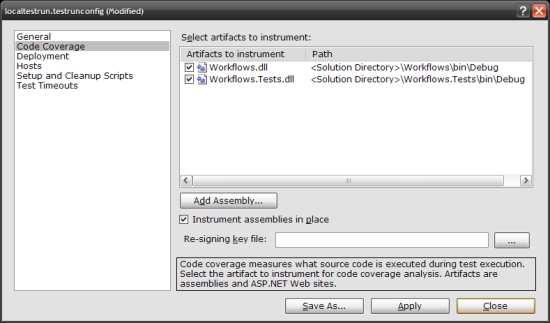
Now I would see that some of my testing code isn’t running, which would be a red flag, because if all the tests are passing, all of the testing code should run as well, right?
As I said before, refactoring the test to check that the event was actually fired is something I should’ve done in the first place. But adding all of the code in code coverage is something to keep in mind. I used to think that testing code should just be “good enough” - that is, it doesn’t need Code Analysis or code coverage, etc. I’m rethinking that notion every day. Even if the tests aren’t being shipped with the product, they’re a vital part of making a product successful and should be treated with the same amount of “respect” as the code it’s testing.
Published: 04.08.2008 08:54:44 AM CST